If you are paying cash for a solar system, this article is not for you. Cash is cash. The system is yours from day one, and there is no financing structure to get wrong.
For most homeowners, though, solar is financed, and the structure of that financing determines something most people do not think about until it is too late: whether the money they pay every month builds anything on their home's appraisal.
Here is the plainest way to say it. A traditional solar loan or lease costs real money every month and gives zero equity back. It is like paying for a pool that the appraiser says does not exist.
The pool that isn't there
Imagine spending $40,000 building a pool in your backyard. You pay the contractor. The pool gets built. It is real, it is in your yard, and you use it all summer.
Then an appraiser comes to value your home and tells you the pool adds nothing. Not because the pool is not real. Because of how you paid for it, the pool cannot be counted.
That sounds absurd for a pool, because pools do not usually work that way. But it is exactly how most residential solar financing works today.
Why the financing structure decides, not the equipment
Residential appraisal policy has a long-standing principle: equipment that a third party can repossess, remove, or that carries a lien making it a separate financial obligation from the home itself, cannot add documented contributory value to the home. The appraiser is valuing the home and its permanent features, not a financial arrangement layered on top of it.
Two financing structures fail that test.
A solar lease means a third-party company owns the panels. The homeowner pays for the electricity produced, typically for 20 to 25 years, but never owns the equipment. The panels sit on the roof, the payment leaves the homeowner's account every month, and the home receives no appraised value for any of it.
A UCC-1 financed solar loan lets the homeowner technically buy the system, but the lender files a UCC-1 fixture filing directly on the equipment. That filing places the panels in a separate financial category from the mortgage, outside the mortgage stack entirely. It shows up on title searches. It has to be tracked down and cleared at refinance or sale. And because of that filing, the appraiser treats the system the same way as leased solar: zero contributory value.
Both structures cost the homeowner real money, month after month. Neither one builds a pool the appraiser can see.

November 2, 2026 makes this permanent and visible
For years, this reality existed inside appraisal policy but was somewhat obscured by narrative appraisal language. An appraiser wrote sentences describing the property. The treatment of solar could vary by appraiser, by market, and by how the narrative was written.
On November 2, 2026, UAD 3.6 takes effect. It is the largest update to residential appraisal standards in over 15 years, and it converts solar from a narrative field into structured, machine-readable data. Every Fannie Mae and Freddie Mac appraisal will report solar in one of three structured categories: owned outright with no lien, financed with a UCC-1 fixture filing, or leased.
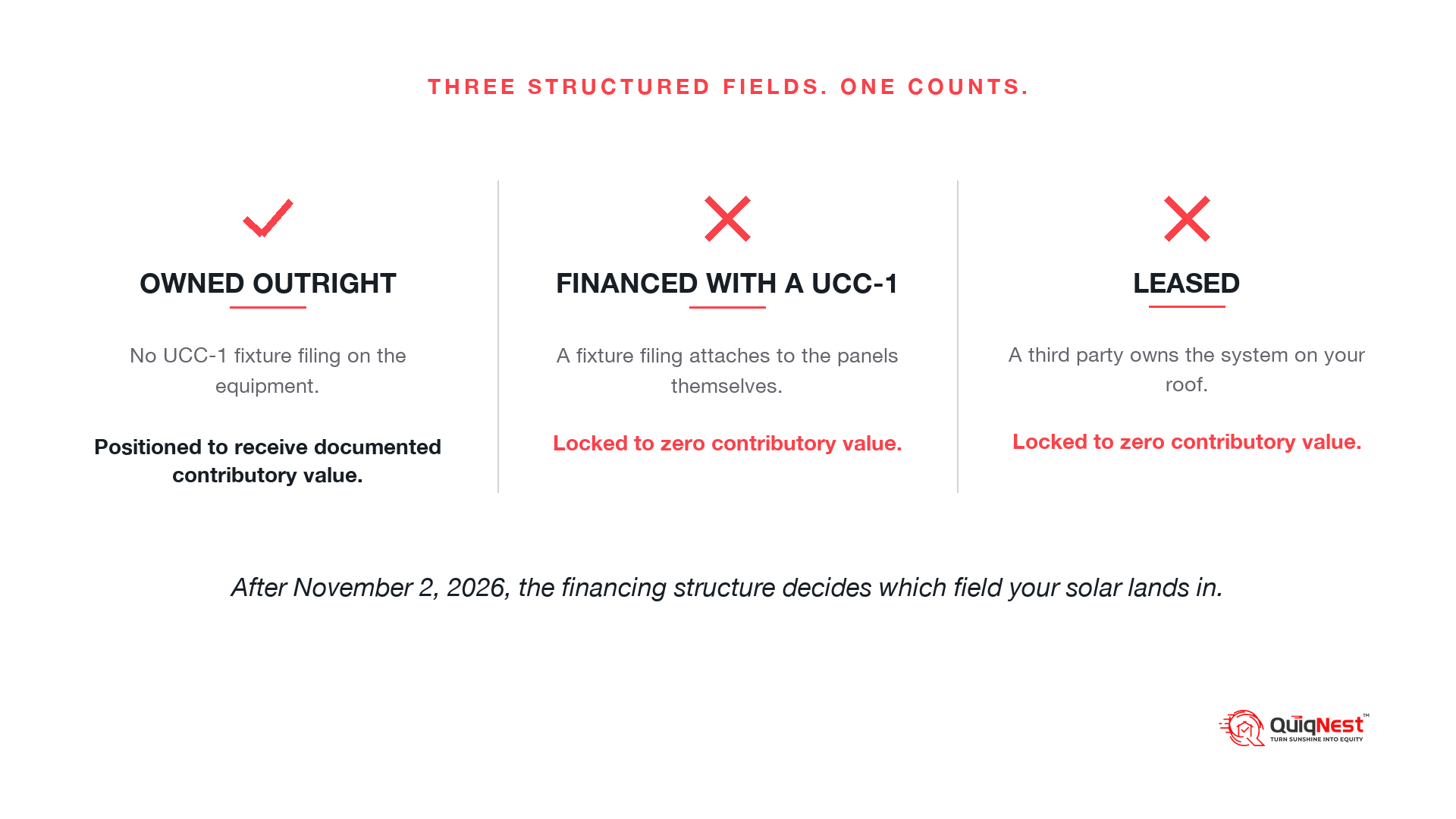
The structured data flows directly into automated underwriting, risk pricing, and collateral analysis. There is no more ambiguity for an appraiser to navigate. Owned solar with no UCC-1 fixture filing is the only category the system is built to recognize as contributing value. The other two are locked to zero, automatically, on every appraisal, at every refinance, at every sale, for as long as the homeowner owns the home.
The pool either shows up on the appraisal, or it never will, and after November 2 that outcome is set the moment the financing structure is chosen.
The financing built for the right side of the line
QuiqBridge™ from QuiqNest exists because homeowners deserve a financing structure where the money they pay every month actually builds something the appraisal can see.
QuiqBridge delivers owned solar at honest cost. The amount financed matches what the system actually costs, not an inflated total with a dealer fee baked into the price. There is no UCC-1 fixture filing on the equipment. QuiqBridge is secured the way home lending is supposed to be secured, through a recorded junior lien that clears through normal closing procedures, not a fixture filing tracked down separately at every future transaction.
It is a second payment, and QuiqNest says that plainly. But it is a second payment with a designed exit. Because the loan balance reflects honest cost rather than an inflated one, the solar can consolidate into the homeowner's primary mortgage through QuiqRefi™ when equity builds or rates improve. The second payment disappears. The homeowner is left with one mortgage and owned solar that the appraisal recognizes as part of the home.
The question to ask before you sign
If you are financing solar and not paying cash, ask the specific question that determines everything else. Does this loan file a UCC-1 fixture filing on the equipment. Does the leasing company retain ownership of the panels. If the answer to either is yes, the pool you are paying for will not show up on the appraisal, on November 2 or any day after.
If the answer is no, and the loan balance matches the honest cost of the system, the pool is real, and the appraiser will see it.
See your QuiqBridge path at quiqnest.com/quiqbridge.
Own the Sun. Not the Risk.™