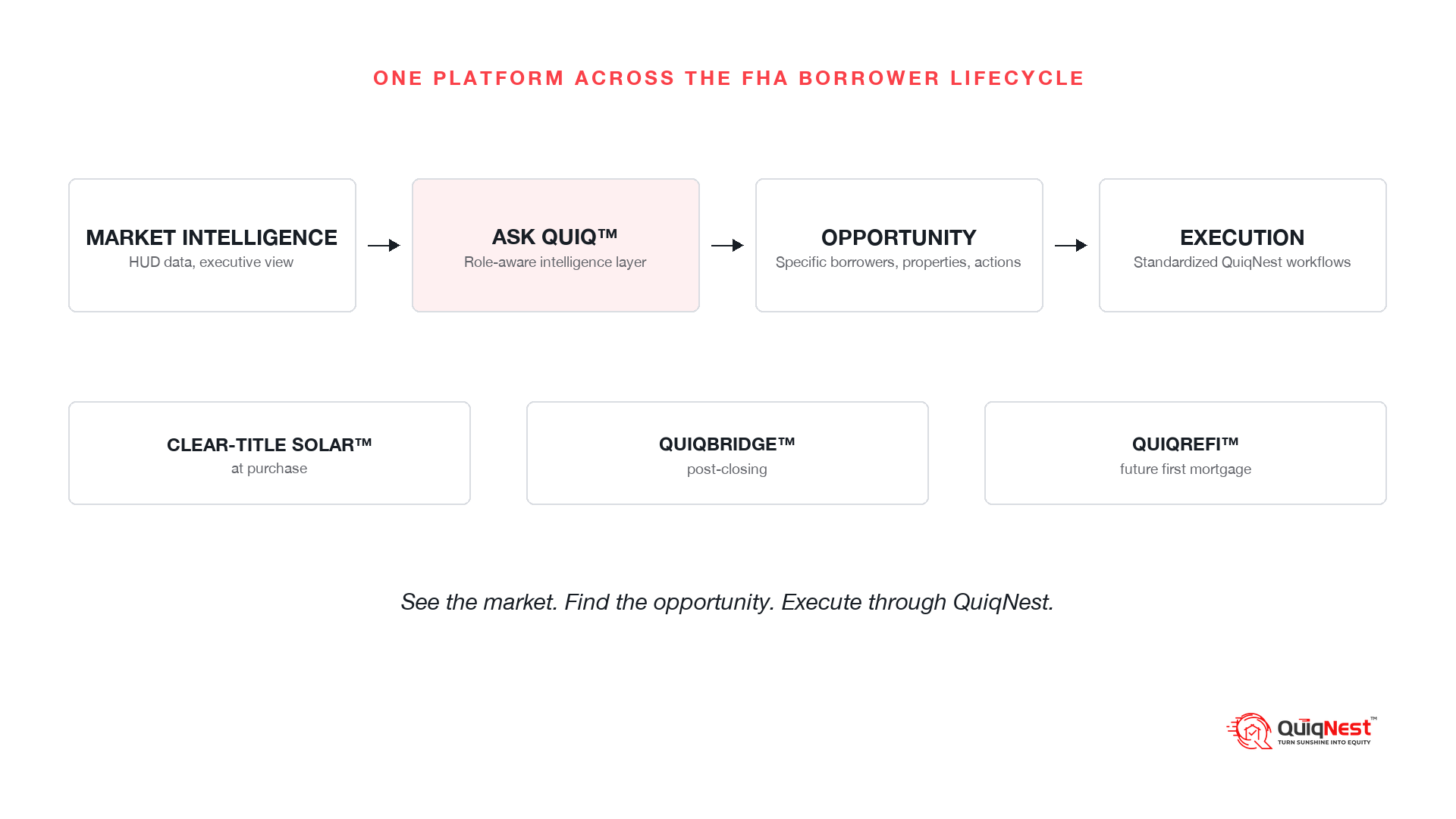
Approving a solar loan is one milestone. Getting that project all the way to an installed, operating system is a longer story, and it runs through several different people along the way.
Most of the industry talks about solar financing as if the approval is the finish line. It is not. It is closer to the starting gun.
What actually happens after approval
The borrower signs. The loan officer moves on to the next file, because that is their job, and it should be. Documents get requested. A system gets designed for the specific property. Paperwork gets reviewed and submitted. Eventually, an installer needs the file to schedule the work, coordinate permits, and get the system on the roof.
Each of those steps involves a different person, often working from a different system, sometimes without a clear view of what the person before them already did.
The result is a familiar pattern. A borrower calls three weeks after closing with a question about their project, and the person who answers the phone, often the loan officer who originated the loan, has no idea what the status actually is, because the project has already moved past their part of the process. Not because anyone failed. Because nobody was watching the whole thing.
Why this gap exists
The gap is not a failure of any single person or company. It is a structural feature of how residential solar financing has typically worked.
A loan officer's tools are built around originating and closing a mortgage. A lender's systems are built around loan performance and portfolio management. A solar installer's tools are built around scheduling, permitting, and system design. Each of these systems does its job well. None of them was built to give any single person visibility into the whole journey, from application to an activated, owned solar system.
So the visibility falls through the cracks between the systems, not because of any one system's failure, but because nobody built the connective layer that sits across all of them.
What QuiqIQ actually does
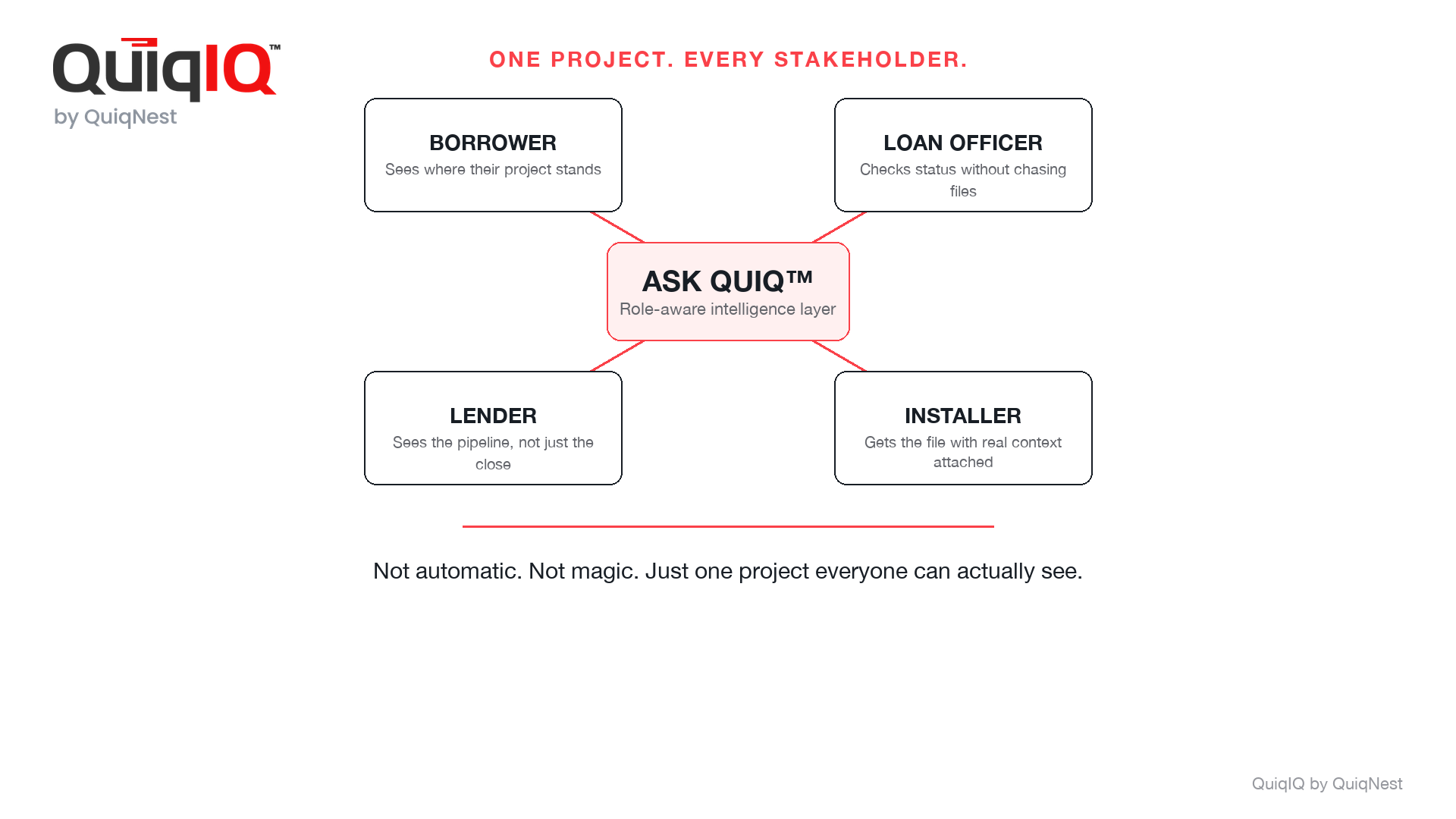
QuiqIQ™ keeps the loan application, the project documents, and the path to installation inside one connected record.
That is a narrower claim than it might sound, and it is worth being precise about it. QuiqIQ does not automate the coordination between a borrower, a loan officer, a lender, and an installer. It does not remove the people from the process, and it makes no promise that everything happens automatically once a file enters the system.
What it does is keep the project visible, in one place, to the people who need to see it. A loan officer checking on a borrower's status is looking at the same underlying record an installer sees when confirming what has already been approved. A lender reviewing a pipeline is seeing real project status, not a summary reconstructed from separate systems that do not talk to each other.
ASK Quiq™, the role-aware assistant built into QuiqIQ, is how each person actually gets their answer. It responds differently depending on who is asking and what they need. A loan officer's question gets a loan officer's answer. An installer's question gets an installer's answer. The underlying project is the same. The lens each person needs is different.
Why this matters for each person in the chain
For a loan officer, the value is straightforward. A borrower relationship does not end at closing, even though the loan officer's direct involvement often does. Being able to check on a project's real status, without tracking down the installer or guessing, means the loan officer can stay a useful point of contact for the borrower well past the closing table.
For a lender, the value is visibility at scale. Instead of a portfolio view that only shows loans that have closed, a lender can see the full journey a project is on, and notice early if something has stalled.
For an installer, the value shows up at the moment a file lands on their desk. Most of what determines whether an install goes smoothly is not the install itself. It is whether the file reflects what has actually happened, what has been submitted, and what is still outstanding, rather than requiring the installer to reconstruct that history from scratch.
What this is not
It is worth being clear about what QuiqIQ is not claiming to do.
It is not a promise that a borrower's project will move faster simply because the software exists. It is not a claim that coordination becomes automatic or that human judgment is no longer needed at any handoff. And it is not built around any specific outcome for any specific project, because every project is different, and the people involved still make the decisions that move it forward.
What QuiqIQ removes is the guessing. Not the people. Not the work. Just the part where everyone is operating from a different, incomplete picture of the same project.
The point of the whole thing
A solar loan approval is one step in a longer process, and the people who carry that process forward, the borrower, the loan officer, the lender, the installer, deserve to be looking at the same picture as it moves.
That is what QuiqIQ was built to do.