When buyers learn that eligible solar can be financed inside an FHA purchase mortgage, the first question is rarely about panels or production. It's about cash. If the solar is part of the loan, does the down payment go up?
The short answer is no: same cash down, with owned solar or without it, subject to program rules. The reason is worth understanding, because it isn't a promotion or a workaround. It's how FHA structures the transaction.
This article walks through the moving parts in plain language: Adjusted Value, the Base Loan Amount, documented cost, and the escrow holdback. Then it covers what doesn't change, and what loan officers and agents should have ready when a buyer asks.
The short version
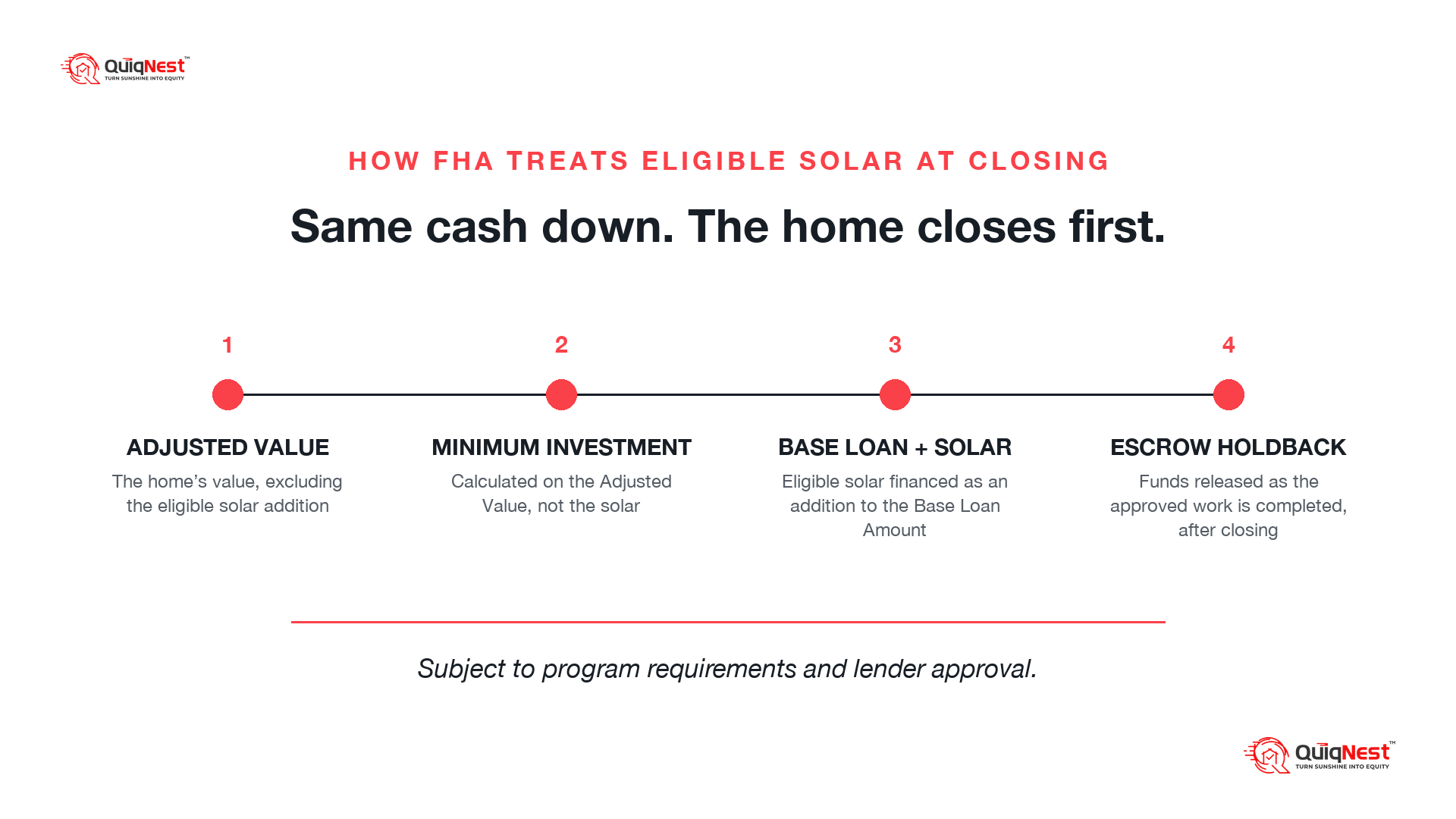
For the purchase transaction, FHA calculates the buyer's minimum required investment on the home's Adjusted Value. The Adjusted Value excludes the eligible solar addition. The eligible solar amount is then financed as an addition to the FHA Base Loan Amount, and the system is installed after closing.
Put those two facts together and the result follows: financing the system does not raise FHA's minimum down payment. Final cash to close depends on the full loan and its costs. Everything here is subject to program requirements and lender approval, and every home and every borrower is reviewed on its own file.
Adjusted Value: the number the down payment is based on
Most buyers think of the down payment as a percentage of "the price." In an FHA purchase, the minimum required investment is calculated on a specific figure, the Adjusted Value.
When eligible solar is part of the transaction, the Adjusted Value leaves the solar addition out. Put precisely: for the purchase transaction, the home's Adjusted Value excludes the cost and installation of the eligible solar system. The eligible solar amount is financed as an addition to the FHA Base Loan Amount, and the system is installed after closing.
That's the whole mechanism behind "same cash down." The minimum investment is figured on the home. The eligible solar is financed on top of it.
Base Loan Amount and documented cost
The second piece is how the solar amount itself is determined. FHA solar financing is based on documented cost: the approved actual project cost, supported by the required invoices, contracts and lender documentation.
That matters because it's easy to assume the solar has to "appraise." Under FHA's Solar and Wind Technologies rules, the appraiser is not being asked to establish a separate solar contributory value as the financing basis. The basis is the documented cost of the eligible system, subject to applicable FHA requirements and limits.
This is also why property-specific preparation matters. QuiqNest prepares the property-specific solar and financing analysis before the purchase, so the solar system for a given home is defined before a buyer makes an offer, not improvised after closing.
What doesn't change
Financing eligible solar inside the purchase changes what the loan includes. It doesn't change the rules the loan is underwritten by.
The loan is still a standard FHA mortgage. The solar doesn't create a different product or a different rate.
Qualification still applies. The solar policy itself does not loosen debt-to-income limits. The borrower qualifies on the full payment, including the financed solar.
The approvals don't disappear. Program requirements, borrower qualification, property eligibility and lender approval all still apply.
That's the honest framing for buyers: same cash down, subject to program rules, with the same underwriting discipline as any FHA purchase.
Why the home closes first
The last piece is timing, and it's where buyers worry most. If solar is part of the mortgage, does the solar work hold up the closing?

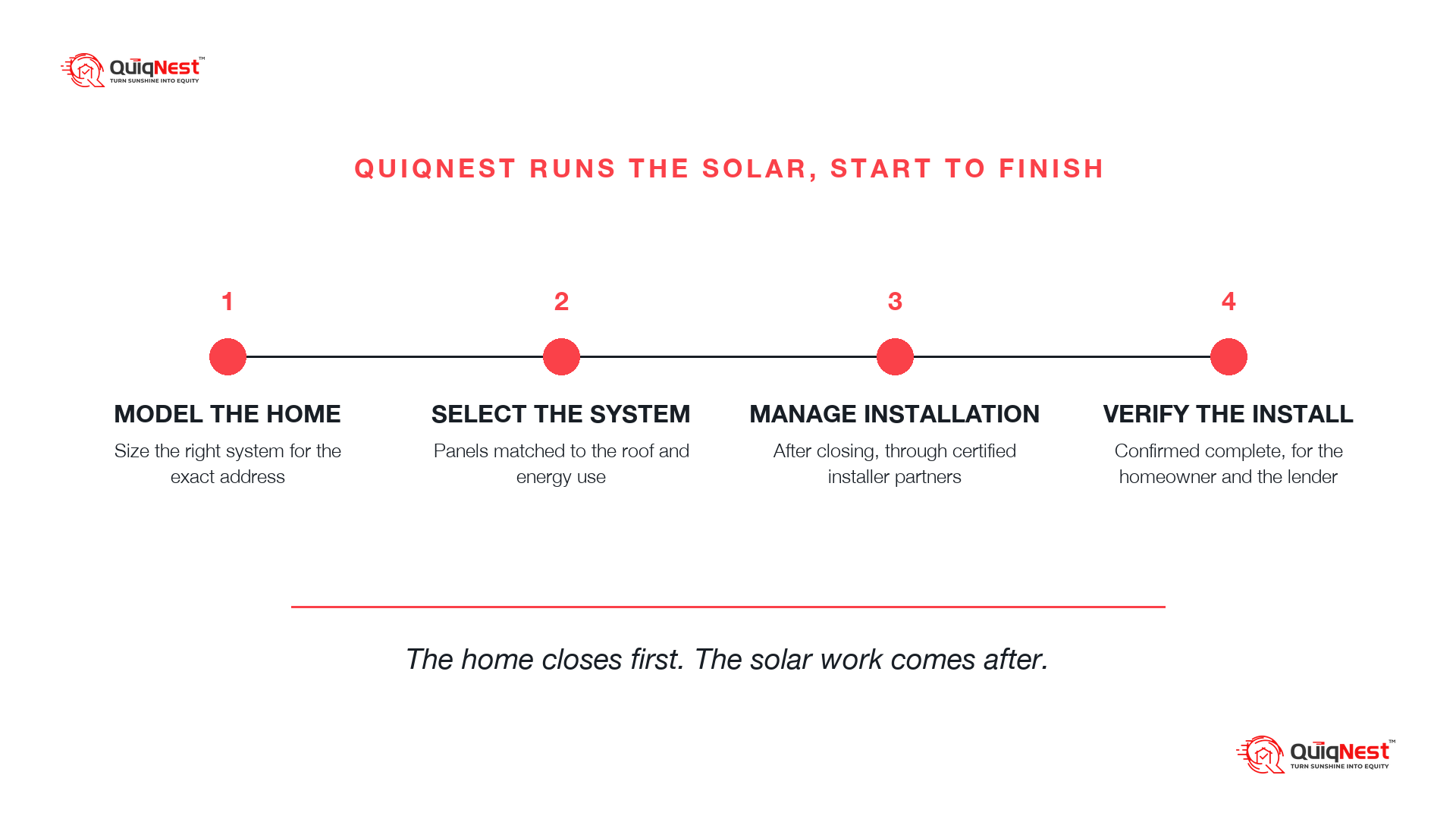
It doesn't, because of the order things happen in. The home closes first. The solar is installed after closing through an escrow holdback: solar funds held at closing and released as the approved work is completed. Installation follows within the applicable completion period, which is at most 120 days. Because the work comes after closing, the closing schedule is not dependent on the solar work.
The work is completed by certified installer partners after the buyer owns the home, and the escrow holdback ties the release of funds to the approved work being finished.
For loan officers and agents: the details worth having ready
Buyers ask agents and loan officers these questions first, so here are the program points in the form you can cite.
The financing basis. FHA solar financing is based on documented cost, subject to applicable FHA requirements and limits. The controlling source is HUD Handbook 4000.1, Section II.A.8.m.
The limits. The solar add-on is the lesser of the documented cost or 20 percent of the appraised value, and with solar added the loan may exceed the county FHA loan limit by up to 20 percent, subject to program requirements and lender approval (HUD Handbook 4000.1, II.A.8.m). Appraised value acts as a ceiling on the add-on, not as the basis for it.
The down payment. FHA calculates the minimum required investment on the home's Adjusted Value, excluding the eligible solar addition, so financing the system does not raise FHA's minimum down payment. Final cash to close depends on the full loan and its costs.
Qualification. The solar policy itself does not loosen debt-to-income limits. The borrower qualifies on the full payment, including the financed solar.
The structure. It's owned solar financed inside the purchase mortgage: not a solar lease, and not a separate solar loan. That's what Clear-Title Solar™ means: solar structured as a permanent home improvement, with no equipment-level UCC-1 fixture filing on the solar equipment under the approved structure.
What to check before your next tour
If you're shopping for a home in Florida with an FHA loan in mind, a few questions are worth asking before you fall for a house:
- Has this home already been checked for owned solar?
- What does the property-specific analysis show for the home?
- What does your loan officer say when you ask, "How would eligible solar be financed inside my FHA purchase?"
Every home in QuiqNest's Solar-Ready Homes™ directory has been checked, so the solar question is answered before you tour, not months after you move in.
Same cash down, with owned solar or without it. The home closes first. And you know what you're buying before you tour.